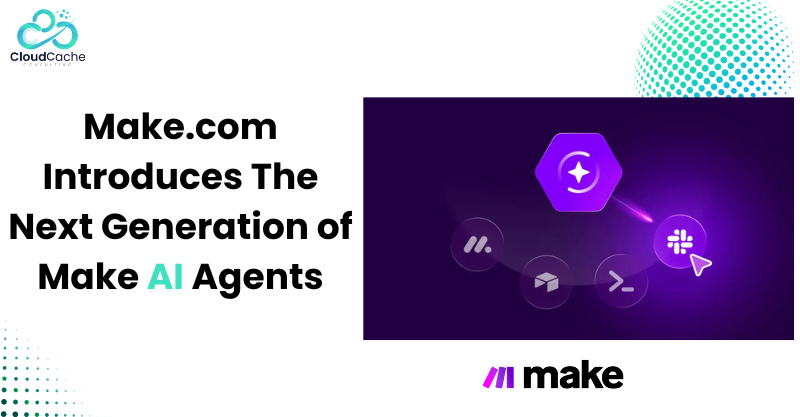
Make.com Introduces The Next Generation of Make AI Agents
Nowadays, most teams are no longer experimenting with workflows. They are running revenue operations, customer onboarding, procurement cycles, reporting systems, and internal approvals through automated scenarios. The next logical step is not more automation. It is intelligent automation that remains understandable.
The next generation of Make AI Agents
When Make first introduced its vision for advanced AI Agents in October 2025, the interest was immediate. The newly released generation of Make AI Agents delivers on that expectation. It moves AI from experimental add-ons into practical, production-ready automation inside the same visual canvas users already trust.
Features
AI Agents Now Inside the Scenario Builder
The most important change is architectural.
AI Agents are no longer separate entities operating in isolation. They are built directly inside the scenario builder canvas. That means:
Below will be in bullets
- Agents interpret inputs within the workflow
- They choose tools based on logic and context
- They adapt dynamically
- And they remain fully embedded in the scenario structure
This matters because automation is not about isolated intelligence. It is about orchestrated processes. When agents live inside the same environment as triggers, conditions, and app modules, they become part of a transparent system rather than an external black box.
For operations teams, this reduces friction. For developers, it simplifies debugging. For business stakeholders, it builds confidence.
Radical Transparency Built Into the Canvas
One of the strongest principles behind Make has always been visual clarity. Users can see each step of their automation. They know which app connects to which module. They understand the data flow.
The new AI Agents extend that philosophy.
Every decision an agent makes is visible directly on the canvas. Nothing operates invisibly in the background. If an agent selects a specific tool or chooses one logical path over another, that reasoning is exposed.
The Reasoning Panel
The new Reasoning Panel provides a real-time breakdown of how the agent is thinking:
- Which tools it calls
- Why it selects a specific action
- What inputs influenced the decision
- How it reached its output
For teams operating at scale, this visibility is critical. It allows faster troubleshooting, easier validation, and greater accountability. If an output needs to be reviewed or audited, the reasoning path is documented.
Full Control Over Inputs and Logic
A common concern with AI systems is the loss of deterministic structure. Make avoids this problem by allowing users to define which parts of a workflow are AI-driven and which remain rule-based.
You can:
- Lock specific input fields
- Control variable boundaries
- Define fixed parameters
- Combine deterministic automation with adaptive reasoning
This hybrid structure is practical. Not every decision should be delegated to AI. Some processes require strict rules. Others benefit from contextual interpretation. With Make AI Agents, both approaches coexist inside the same workflow.
In-Canvas Chat for Faster Iteration
Building intelligent workflows often requires testing, refinement, and clarification. Traditionally, that meant switching tools or editing configurations externally.
Now, you can chat directly with your AI agent inside the Make canvas.
This feature allows you to:
- Test how the agent interprets instructions
- Adjust prompts without leaving the workflow
- Ask follow-up questions
- Refine behavior in real time
Iteration becomes more natural. Instead of guessing how the system will respond, you can observe and refine it immediately.
For teams building complex automation systems, this shortens the path from initial concept to stable execution.
Multi-Modal Support for Real-World Workflows
Text-only AI is limiting. Most real workflows involve files, structured data, and documents.
The next generation of Make AI Agents includes built-in multi-modal support. Agents can now:
- Accept PDFs
- Process images
- Work with CSV files
- Generate structured outputs
- Produce documents directly in the workflow
Consider practical examples:
- Processing vendor invoices in PDF format
- Extracting data from uploaded CSV reports
- Reviewing images for classification
- Generating structured reports based on source files
Cross Teams and Workflows Collaboration
Automation becomes more valuable when it is reusable.
Previously, scaling AI logic across teams often required duplication. Now, pre-built AI Agents and complete scenario solutions can be shared.
This enables:
- Cross-team knowledge transfer
- Faster deployment of proven workflows
- Standardization of intelligent processes
- Reduced configuration time
Instead of rebuilding similar logic repeatedly, teams can adapt and refine shared agents for new contexts.
A Library of Agents
Make is also introducing a structured Library of Agents designed for real business use cases. These are not demo scripts rather they are functional templates for workflows such as:
- Inventory management
- Data triage
- Research automation
- Report generation
- Operational review processes
Each template demonstrates how deterministic automation and AI reasoning operate together. This helps teams understand architecture, not just outcomes.
For organizations new to AI-based workflows, the library reduces uncertainty. For experienced builders, it accelerates deployment.
Orchestrating Across 3000+ Apps
Make is known for its extensive integration ecosystem. The new AI Agents can orchestrate workflows across more than 3000 applications available within the Make environment.
This creates significant operational flexibility.
An agent can:
- Interpret incoming data
- Decide which app module to trigger
- Execute actions across multiple systems
- Route outputs dynamically
Because these actions remain visible inside the canvas, teams can monitor cross-system orchestration without losing structural clarity.
Intelligence is layered onto connectivity. Not isolated from it.
Scaling AI Without Losing Oversight
As AI moves from experimentation to production, cost control and governance become critical.
The new Make AI Agents address this by maintaining:
- Clear visibility into execution paths
- Defined tool access
- Transparent cost scaling
- Predictable workflow structures
When AI decisions influence business processes, organizations need auditability. The canvas-based design ensures that scaling does not reduce oversight.
You gain adaptive decision-making without sacrificing accountability.
Practical Business Impact
The improvements are not theoretical. They translate into tangible outcomes:
- Faster workflow development cycles
- Reduced debugging time
- Improved collaboration across teams
- Greater confidence in AI-driven decisions
- Lower operational friction when handling unstructured data
Businesses can automate complex work while still understanding how results were produced.
This balance is often missing in AI implementations. Make addresses it directly.
Moving From Experimentation to Real Value
Many organizations have tested AI tools in isolated environments. Pilot projects generate interest, but integration into core operations often stalls due to trust and visibility concerns.
By embedding AI Agents directly inside its automation framework, Make reduces that gap.
Users no longer need to choose between deterministic control and adaptive intelligence. They can design workflows where AI interprets context while automation maintains structure.
That combination is what transforms AI from novelty into operational infrastructure.
Availability
The next generation of Make AI Agents is available for users ready to build. Whether you are automating internal processes, customer interactions, reporting pipelines, or document handling systems, the foundation remains consistent:
- Visual architecture
- Transparent reasoning
- Controlled inputs
- Shareable solutions
- Multi-app orchestration
Final Words
Make has extended its core philosophy into the AI layer rather than replacing it.
For teams that depend on automation daily, this evolution is practical. It strengthens clarity while expanding capability.
AI is becoming part of business infrastructure. The key question is not whether to adopt it, but how to adopt it responsibly.
With the new generation of Make AI Agents, intelligence operates inside a system you can see, inspect, refine, and share. That visibility may prove to be the most important feature of all.
For more such updates stay in touch with CloudCache Consulting.