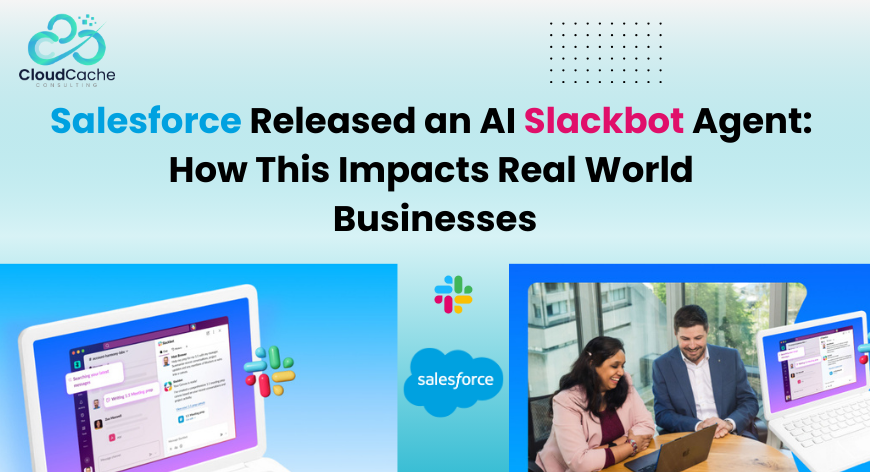
Salesforce Released an AI Slackbot Agent: How This Impacts Real World Businesses
Most workplace tools promise productivity. Very few actually change how work gets done. Salesforce recently launched AI Slackbot agents. In this, Salesforce has expanded the role of Slackbot from a simple productivity feature to a fully realised enterprise AI agent. It is being positioned as an intelligent, enterprise-grade work companion that understands context, permissions, systems, and the way teams actually operate inside Slack.
What is AI Slackbot ?
At its core, Salesforce’s Slackbot is designed to be deployed where work already happens inside Slack and to work with the context that people already have. Traditional AI assistants often require users to switch applications, import data, or feed context manually.
AI Slackbot avoids this by staying inside conversations where decisions already happen. It listens to the same channels, documents, and threads that teams rely on every day. There is no new interface to learn and no behaviour change required. That alone lowers resistance across organisations.
This isn’t just a slick enhancement to auto-completion or bot replies.
Features
Slackbot is engineered with many features to support meaningful tasks that matter in typical business settings. That includes summarising discussions, locating documents, preparing briefings, drafting notes, and helping to organise work across teams without extra application switching. The integration with other enterprise systems — particularly Salesforce data — gives Slackbot an edge over generic assistants that can only offer surface-level help. With Slackbot, a customer account briefing can combine Slack discussion history with CRM insights and files from shared repositories, delivering a more complete view than any single application could on its own.
One of the more notable features of Slackbot is how it bridges conversation with action. When a user asks something like where a key document resides or what decisions were made in a recent project thread, Slackbot goes beyond retrieval. It can produce draft deliverables, like meeting notes or project summaries, that users can refine and share with colleagues. It also propagates basic calendar coordination and task reminders from within Slack itself.
A common hurdle with enterprise AI adoption is trust. IT teams often resist deploying agents that lack clear boundaries around data privacy or that require sensitive company information to be imported into external services. Salesforce addresses this by leveraging Slack’s existing enterprise security model. Slackbot respects existing permissions. If someone does not have access to a file, record, or channel, Slackbot does not invent visibility. It works within the same guardrails IT teams already manage. That makes adoption conversations simpler, especially in regulated industries where experimentation is limited.
Why It matters
The announcement also lays out a vision for Slackbot as part of a wider ecosystem of AI agents. Over time, as more specialised agents are introduced across an organisation — for functions such as HR, sales, or business intelligence — Slackbot will act as a “front door,” orchestrating requests and routing them to the right components behind the scenes. Users won’t need to remember which tool does what; they can stay in a familiar conversational interface and let Slackbot determine how to complete the task.
Future Aspect
From a business strategy perspective, Salesforce’s approach reflects a broader trend in the enterprise AI market. Tool vendors are recognising that generic assistants that simply answer questions are not enough. The next wave of adoption depends on agents that can operate with real business context, leverage existing corporate data, and integrate with workflows instead of being siloed features that employees need to learn separately.
The comparison with other enterprise assistants like Microsoft, Google is unavoidable. Others are pushing AI deeper into productivity tools. Salesforce’s approach stands out because it prioritises conversational workspaces rather than documents or spreadsheets. Slack has always been where decisions are debated, reversed, clarified, and approved. Enhancing that space has a different impact than enhancing static files.
Early feedback from internal and pilot users suggests tangible productivity gains. Some teams report that Slackbot helps cut down routine busy work and provides easily accessible summaries or insights that would otherwise require considerable manual effort. Time savings and improved focus on high-value work are cited frequently in early use cases. At the same time, businesses which adopt this notice that its experience isn’t smooth still. Like many other new emerging AI tools, Its effectiveness also depends on how precise and disciplined reps are with naming conventions, documentation, and access controls. Messy environments still produce messy outcomes. Salesforce appears aware of this and has positioned Slackbot as something that improves with better organizational habits, not a shortcut that replaces them.
Availability
The January 2026 rollout is intentionally phased. Salesforce is giving administrators control and time to adjust. That signals maturity. Rushed deployments often create backlash. Measured adoption builds confidence.
As organisations assess the practical impact and refine adoption strategies, the tool’s real value will be realised in how it changes patterns of work and enables teams to stay focused on strategic priorities rather than operational drudge.
For more such updates stay connected with CloudCache Consulting.